UAP Disclosure Act Gutted in FY2024 NDAA: Review Board Stripped
Learn how the UAP Disclosure Act was narrowed in the FY2024 NDAA, what Congress cut, and which National Archives records rules survived.


The UAP Disclosure Act promised a disclosure system with an independent body able to review government secrecy claims. What Congress enacted in the FY2024 NDAA was materially narrower: a UAP records process centered on the National Archives, without the proposed Review Board or several tools intended to give disclosure requirements real force.
That distinction is the point of calling the measure “gutted.” It does not mean Congress erased every UAP-related records provision, nor does it establish that allegations involving concealed programs or non-human intelligence are true. It means the final statute retained a collection-and-release framework while omitting the independent oversight and leverage that would have distinguished the original Schumer-Rounds proposal from an ordinary agency-led records process.
This article compares the proposal with the enacted text provision by provision: who would have reviewed postponements, what authority was lost or narrowed, what records mechanism survived, and what can, and cannot, be inferred from the legislative outcome. The evidence supports a precise conclusion: the archive remained, but the enforcement architecture did not.
The FY2024 NDAA Did Not Eliminate UAP Disclosure, But It Removed Its Core Enforcement Model
The decisive change occurred between the Senate’s proposed language and the conference-negotiated bill that became Public Law 118-31 on December 22, 2023. The final FY2024 NDAA retained a UAP Records Collection at the National Archives and a process for agencies to identify, review, transmit, and publicly disclose covered records.
That survival matters, but it is not the same system the Senate-backed UAP Disclosure Act contemplated. The proposal paired records collection with an independent UAP Records Review Board: a body designed to assess agency requests to postpone disclosure rather than leaving the underlying executive-branch process without that outside review layer. The enacted language created no such board.
The final statute also omitted the proposal’s most unusual leverage mechanisms, including provisions aimed at obtaining certain privately held material and a broader controlled-disclosure structure. In practical terms, the surviving law organizes and channels records into an archive; the discarded model would have added an independent referee and stronger tools for resolving resistance to release.
That is the concrete basis for “gutted.” It describes the removal of the proposal’s enforcement model, not proof of any alleged hidden UAP or non-human-intelligence program. Those allegations remain allegations; the enacted law establishes a records framework, not factual confirmation of them.
What the Original Schumer-Rounds UAP Disclosure Act Proposed
The Schumer-Rounds proposal borrowed its basic architecture from the President John F. Kennedy Assassination Records Collection Act: identify a defined body of records, presume public disclosure, and require a separate body to decide whether secrecy could continue. Its premise was procedural rather than evidentiary. References to alleged recovered technology or non-human intelligence defined categories that could be reviewed; they did not establish that such material exists.
At the center was a presidentially appointed UAP Records Review Board. The proposed independent Review Board would have consisted of citizens selected for professional qualifications, rather than officials from the agencies whose records were at issue. It was meant to receive and assess agency postponement claims, direct disclosure where the statutory standard favored release, and supervise compliance with the collection process. That design matters because an agency seeking to withhold a record would not have been the final practical judge of its own rationale.
The proposal treated postponement as an exception to disclosure. Agencies could seek to delay release on specified grounds, but the Review Board would centrally test those claims against the Act’s standards and establish the terms of any continued withholding. A records-only system can require agencies to locate and send material to an archive; this model added an adjudicative checkpoint over whether the public could actually see it.
It also directed the President to develop a controlled disclosure campaign plan for records and information covered by the measure. The point was to organize disclosure across government, including the handling of material whose release might require sequencing or protective measures, rather than leaving each department to act in isolation.
Finally, the proposed framework reached beyond routine archival transfer. It included provisions concerning government possession and control of UAP-related records and contemplated federal authority affecting certain privately controlled alleged technologies or biological material. Those provisions were unusually expansive, but their inclusion should not be read as congressional confirmation of the allegations they described. Together, the board, postponement review, disclosure plan, and acquisition authority made the original UAP Disclosure Act a disclosure-enforcement design, not merely a filing requirement.
How the Review Board Was Removed in Conference Negotiations, and What Is Actually Known
The legislative turning point was the reconciliation of the Senate and House defense bills. The Senate had adopted the Schumer-Rounds disclosure language as an amendment to its FY2024 NDAA; the enacted compromise instead used a shortened UAP-records subtitle. In that conference-negotiated text, Congress did not establish a Review Board with a later expiration, cut its funding, or dissolve it. The board simply never appeared in Public Law 118-31.
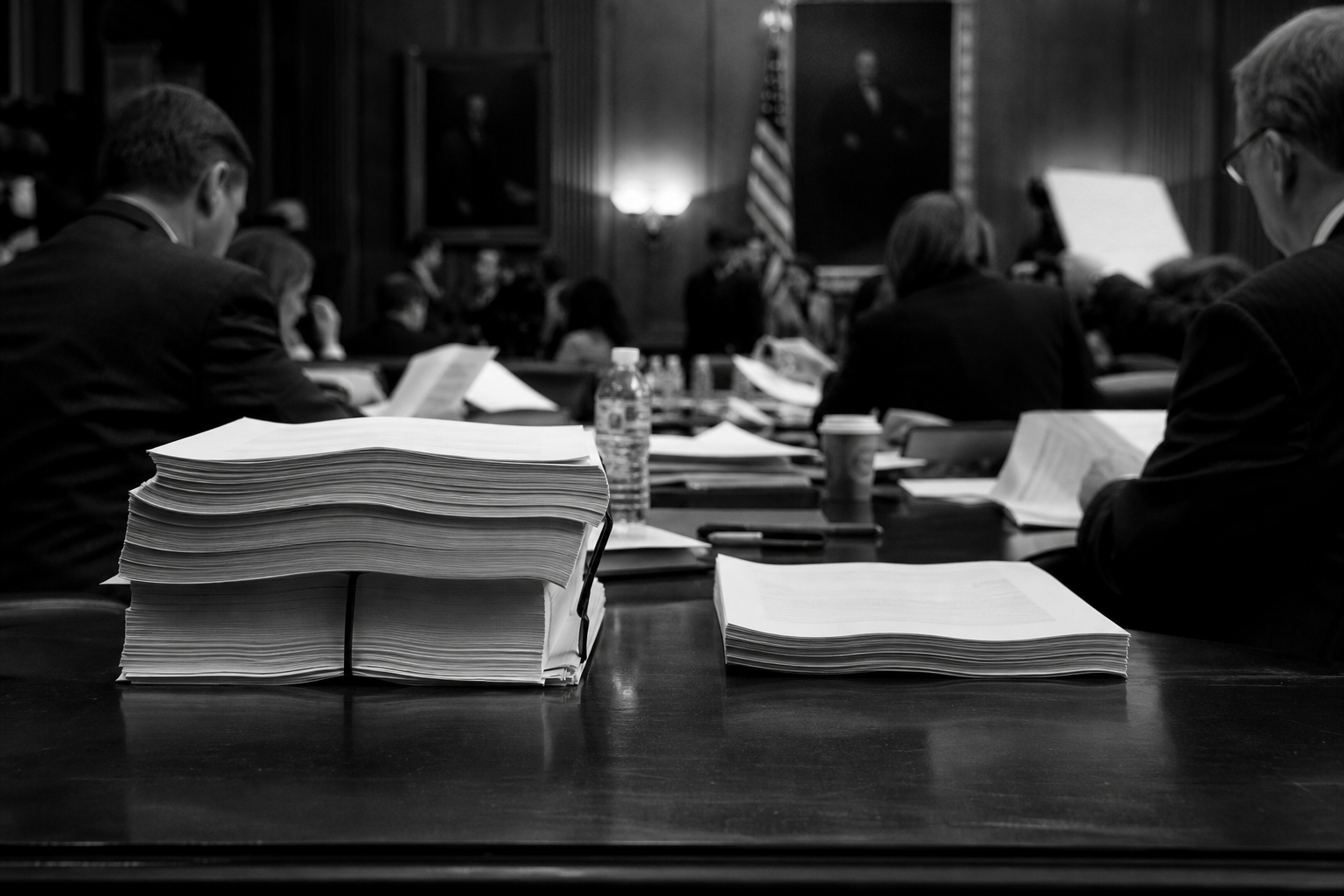
That distinction makes the statutory comparison unusually clear. A proposal can survive negotiation intact, survive in revised form, or be omitted altogether. Here, the archival collection and agency-review obligations survived in revised form, while the independent review structure did not. The practical tradeoff was control: the final framework could organize records for transfer and release, but it lacked the proposed outside body that would have assessed agency requests to postpone disclosure.
What the public record does not provide is a definitive account of every private conference negotiation. The final statutory text identifies the provisions Congress enacted; it does not name individual legislators, agencies, contractors, or other participants responsible for removing particular provisions, and it does not state a motive. Statements by sponsors after enactment and contemporaneous reporting can document that the broader language encountered opposition and was narrowed in negotiations, but they do not convert reported political accounts into a formal finding of causation.
Claims that lobbying by defense contractors, pressure from intelligence agencies, or a government UFO cover-up caused the outcome therefore remain claims unless independently substantiated. The strongest documented conclusion is narrower: the mechanisms that would have imposed independent review and broader disclosure leverage were omitted from the final compromise. In that concrete, legal sense, describing the UAP Disclosure Act as gutted identifies what was removed without claiming that the NDAA proved the existence of concealed UAP programs or non-human intelligence.
What Was Stripped or Narrowed: Review, Eminent Domain, and Disclosure Leverage
The clearest way to measure the reduction is to compare authority, not rhetoric. The proposed system paired a disclosure presumption with institutions and tools designed to challenge continued secrecy. The enacted system retained a records pathway but not those counterweights.
| Proposed mechanism | FY2024 NDAA result | Practical consequence |
|---|---|---|
| A presidentially appointed UAP Disclosure Act Review Board | Omitted | No independent body was created to stand between an originating agency and a contested withholding decision. |
| Board review of postponement requests, with power to evaluate claimed harms and direct disclosure under the proposal’s standards | Omitted | Agencies retained substantially more control over whether material could remain nonpublic; difficult disputes had no new specialist adjudicator. |
| A presidential controlled-disclosure campaign plan | Omitted | Congress did not impose the proposed coordinated executive process for planning releases, public communication, and related disclosure steps. |
| An eminent-domain provision concerning privately controlled recovered UAP material or biological evidence | Omitted | No new statutory pathway authorized the federal government to assert possession and control over such privately held material through that proposal. |
“Eminent domain” here matters because it would have been a coercive acquisition tool, not a records-request rule. The proposal’s language did not establish that any recovered material existed, identify a private holder, or automatically transfer property to the government. It contemplated federal authority to obtain a narrowly described category of alleged material if it were privately controlled. Its omission means the FY2024 NDAA created no such authority.
The same distinction applies to the controlled-disclosure concept. A records collection can require agencies to search, identify, review, and transmit covered records; a disclosure campaign would have added centralized direction over how the executive branch carried out a broader release effort. The final law chose the former architecture without the latter.
That is why the loss was more than symbolic. The surviving provisions could preserve and organize a body of UAP records, while the omitted provisions would have supplied independent review, a coordinated release mechanism, and potential leverage over material outside ordinary federal custody. “Alien disclosure” is popular shorthand, not a finding made by either the proposal or the enacted statute.
What Survived: The UAP Records Collection at the National Archives
Public access begins with a collection, not with a single mass release. The enacted FY2024 NDAA directed the National Archives and Records Administration to establish the UAP Records Collection: a centralized body of qualifying federal records that can be identified, preserved, and made available in one archival setting.

Its coverage is broad in institutional terms. Federal agencies are required to identify records in their custody that relate to unidentified anomalous phenomena and transmit them to the Archivist for inclusion in the collection. That obligation reaches records created by an agency as well as material it received, while leaving the originating agency responsible for the initial review needed to determine whether a record may be released immediately or must be temporarily withheld.
The statute adopts a presumption of public disclosure. In practical terms, a qualifying record is meant to be publicly available in full unless a lawful postponement applies. The difference is important: a collection rule gives researchers a defined destination and makes disclosure the default posture; it does not erase every established basis for protecting sensitive information.
Postponement remains available where release would create an identifiable harm recognized by the law, including damage to national security, intelligence activities, military defense, foreign relations, law-enforcement interests, or personal privacy. Agencies must specify the grounds for withholding rather than treating a UAP label as a free-standing secrecy category. A released record, therefore, may be complete, partially redacted, or deferred pending later disclosure.
NARA’s role is archival and public-facing: it maintains the collection and provides access to material transferred for disclosure. The Archivist administers that process. Agencies, however, still perform the decisive first-stage work of locating records, reviewing them, and asserting any postponement claim. That division makes the UAP Records Collection National Archives framework a meaningful preservation and publication mechanism, but not an independent declassification tribunal.
The final law thus created a route by which UAP records can enter a dedicated public collection. It did not enact the proposed independent Review Board to test disputed agency withholdings, and it did not promise that every covered record would appear immediately or without redaction. The surviving framework matters precisely because it is real statutory infrastructure, yet its effectiveness depends heavily on agency identification, transfer, and disclosure decisions.
Why “Gutted” Is Fair, But Does Not Mean Disclosure Is Impossible
“Gutted” is a description of institutional loss, not a claim that Congress repealed UAP-related disclosure. The FY2024 NDAA preserved a records collection and a disclosure process, but omitted the independent Review Board, the proposed challenge to agency postponements, and the extraordinary leverage intended to reach material outside ordinary federal custody. That changed who could contest secrecy and how much power the framework had to produce disclosure.
It also leaves room for meaningful releases. A federal agency can identify and transfer records, NARA can make releasable material available, and Congress can later amend the law. None of those possibilities, however, retroactively supplies the oversight structure absent from the enacted FY2024 measure.
For future UAP news or UFO news, identify the event before drawing conclusions. A proposed bill signals an ambition; enacted law creates binding statutory authority; agency implementation shows how that authority is being used; a hearing develops a public record but does not itself change the law; and an allegation remains an allegation unless independently established.
The same discipline applies to later amendments and new UAP bills, including later disclosure proposals, and reports branded around UFO sightings 2025. They may be important developments, but they are not part of what the FY2024 NDAA enacted. Nor does the statute prove a hidden-program or non-human-intelligence claim. Its lasting lesson is narrower: records access survived, while the independent machinery designed to test and overcome resistance to disclosure did not.
The Record Survived, but the Enforcement Architecture Did Not
The practical test is not whether a disclosure label exists, but whether the system can turn a disputed record into a public one. The enacted archival process can centralize material, preserve it, and make releasable records accessible through the National Archives. Those are meaningful capacities: they create a durable place for records to be found, compared, and scrutinized rather than left scattered across agencies.
Its limits are equally concrete. The FY2024 NDAA did not enact the proposed independent Review Board that could assess continued secrecy claims, nor did it retain the proposal’s stronger controlled-disclosure and acquisition leverage. An agency-centered review process can produce releases, but it leaves more of the crucial decisions, identification, withholding, redaction, and timing, within the executive-branch structure whose records are at issue.
That is the measured meaning of “gutted” in the UAP Disclosure Act debate. Congress preserved a records pathway, not the external enforcement architecture intended to press that pathway toward disclosure. Progress remains possible through agency implementation, congressional oversight, and later legislation; none of those possibilities means the omitted independent-review mechanism was enacted. The statute establishes no proof of alleged hidden programs or non-human intelligence, only a narrower framework for handling relevant federal records.
Frequently Asked Questions
-
What was removed from the UAP Disclosure Act in the FY2024 NDAA?
The final FY2024 NDAA omitted the proposed independent UAP Records Review Board, Board review of agency postponement requests, a presidential controlled-disclosure campaign plan, and eminent-domain authority for certain privately controlled alleged UAP material. Public Law 118-31 retained a records process but not the proposal’s enforcement mechanisms.
-
Did the FY2024 NDAA create a UAP Review Board?
No. Public Law 118-31, enacted on December 22, 2023, did not create the presidentially appointed UAP Records Review Board proposed in the Schumer-Rounds amendment. The Board was omitted from the final conference-negotiated text rather than created and later dissolved.
-
What is the UAP Records Collection at the National Archives?
The UAP Records Collection is a centralized National Archives collection for qualifying federal records related to unidentified anomalous phenomena. Agencies must identify records in their custody, review them, and transmit them to the Archivist, while NARA maintains the collection and provides public access to releasable material.
-
Does the current UAP records law require the government to disclose UFO records?
The law establishes a presumption that qualifying UAP records should be publicly disclosed, but it permits temporary postponement when release would cause identifiable harm to national security, intelligence activities, military defense, foreign relations, law enforcement, or personal privacy. Records may therefore be released in full, redacted, or deferred.
-
What should you look for when comparing the original Schumer-Rounds UAP Disclosure Act with the law now in force?
Check whether the framework includes independent review of agency withholding claims, coordinated disclosure planning, and authority to obtain material outside normal federal custody. The enacted law has the National Archives records collection, but it lacks the independent Review Board and broader disclosure leverage that made the original proposal stronger.