NARA Opens UAP Records Collection in 2025: Public Releases Begin Rolling Out
Explore the UAP Records Collection National Archives rollout in 2025, what is public, how to search it, and what the records do not prove.


The consequential development is not a declaration about what unidentified anomalous phenomena are. It is the prospect of a more centralized public route into federal records that have often been scattered across agencies, series, and access systems. The UAP Records Collection National Archives initiative should therefore be read first as an archival-access story: materials may become easier to discover in stages, while their content, provenance, and release status still require item-by-item scrutiny.
“Rolling out” does not mean every responsive record is online, unredacted, or newly declassified. A catalog entry can establish that NARA has described a record or series; a digitized file makes a particular copy viewable; and a declassified document may still require separate processing before it appears in a public interface. Those are different milestones with different evidentiary weight.
This article follows that distinction. It explains what the NARA UAP collection is intended to make discoverable, how to trace an item from collection page to catalog description and available file, and how to distinguish an agency record from the claims made about it. Public availability can illuminate the government’s record trail; it does not, by itself, establish extraordinary explanations for any UAP report.
NARA’s UAP Collection Is Becoming a Public Discovery Point, Not a Verdict on UAP Claims
As of August 5, 2026, the research file contains no dated 2025 NARA launch notice, archived UAP collection landing-page capture, or catalog identifier for a first UAP-specific release. The headline’s “rolling out” language should therefore be read narrowly: it describes a centralized National Archives discovery route under examination, not a demonstrated posting of every responsive federal record.
The practical value is traceability at the item level. A National Archives Catalog description can identify an originating agency, record date, series title, archival identifier, and access status; a linked digital object is the stronger signal because it lets a reader inspect the actual file NARA has made viewable. A collection page points readers toward material, while an item record and attached file establish what is publicly available in a particular case.
That distinction is essential in UFO news and UAP disclosure coverage. A catalog hit or a newly viewable memorandum can document that an agency created, retained, or transferred a record. It does not, without direct support in the document itself, establish alien visitation, non-human intelligence, crash-retrieval activity, or a coordinated government cover-up.
For each claimed release, preserve five details: the agency of origin, document date, series or catalog ID, access notation, and URL for any downloadable file. Those details allow a reader to follow an assertion back to a defined archival item rather than relying on a screenshot, a dramatic excerpt, or an unsupported claim that something “was released.”
What the National Archives UAP Records Collection Is
An archival collection is best understood as an organizing layer, not as a single evidentiary file. In this context, the National Archives UAP Records Collection would group or point users toward federal material identified as relevant to UAP matters while leaving each item connected to the office or agency that created it.
That provenance is the difference between a useful research trail and a catch-all folder. A memorandum retains its originating agency and date; a photograph, briefing, correspondence file, technical report, or index entry has its own format and surrounding series; and a catalog description may identify a record without providing its full text online. The grouping can make related holdings easier to discover, but it does not turn unlike records into one unified account.
Descriptions also answer different questions from the documents themselves. Fields such as creating agency, record group, series title, date range, identifier, digitization status, and access restriction help establish where an item belongs and whether a reader can view it. They do not independently establish that the event described was anomalous, accurately reported, or unresolved.
The practical implication is that “collection” should not be read as the name of a new investigation, a definitive government report, or a finding that every included record concerns an unidentified object. It is a discovery framework whose contents can include routine administrative material, historical reporting, references to investigations, and records still subject to review or restricted access. A document’s placement may explain why it was gathered for researchers; its provenance, full text, and release status determine what can responsibly be inferred from it.
Why the Collection Opened or Became More Accessible in 2025
The 2025 label is best treated as an access milestone requiring item-level proof, not as a single event that changed every UAP-related file at once. The research supplied for this section does not identify an enacted mandate, NARA directive, or dated agency notice that establishes a uniform opening date or release schedule. That leaves a narrower, supportable account: material can become easier to find as archival work makes descriptions, links, or selected files public.
The administrative path has several separate stages. An agency first identifies records that may fall within a UAP-related records-review scope; a records transfer then moves custody or provides archival control without changing what the document originally was. NARA can process the material by assigning it to a series, creating a catalog description, and linking related holdings. Those steps improve discovery, but a catalog entry is an index to a record, not necessarily the record’s full public text.
Digitization is another step rather than a synonym for release. A scanned memorandum or image can be placed online as a digitized record, while another item in the same series may remain viewable only in an archival facility or await processing. Separately, an access or declassification review determines whether protected information can be released, withheld, or redacted. A transfer therefore does not show that a file was newly created, newly declassified, independently authenticated, or published in complete form.
For readers, the useful checkpoint is the combination of an originating agency, date, series or identifier, access statement, and attached digital object. A strong public release trail lets a reader distinguish a fully viewable file from a descriptive listing and see whether redactions or restrictions remain. That discipline also keeps archival availability separate from UAP disclosure claims: the appearance of a government record establishes that the record is being described or made available, not that every allegation or interpretation within it has been proved.
What Records Have Begun Appearing, and How to Read Their Status
The earliest useful signal is often modest: a new catalog description, a revised finding aid, or a link that exposes a file already public elsewhere. None of those, standing alone, identifies a newly declassified document. On the material available for this article, no item-level NARA record has been supplied that permits a verified list of first 2025 additions, their originating agencies, or their release dates. It would be inaccurate to label particular files as the collection’s initial releases without those details.
Readers will encounter several different forms of availability. A catalog entry is a searchable description, often enough to identify the creator, date range, series, and location, but may contain no downloadable pages. A finding aid maps the contents and arrangement of a larger body of records, helping researchers locate relevant folders without reproducing every document. A digital object is the stronger public-access signal: it lets the reader open scans, photographs, or files attached to the description.
- Newly grouped means an existing description or record series has been linked to the UAP records collection; it does not show when the underlying document became public.
- Previously public means a file may have long been available through NARA or another government channel and is newly easier to find.
- Released with redactions means the visible document is only the releasable portion; omissions can limit what its language establishes.
“UAP,” “UFO,” or a striking incident name in a title is a weak interpretive signal. The stronger reading starts with the originating agency, document type, date, recipients, and surrounding series. A report recording UAP sightings establishes that an office recorded or discussed a claim; it does not authenticate every observation, identify an object, or substantiate a broader allegation.
How to Search the NARA UAP Collection Without Mistaking a Catalog Hit for a Release
Search from the collection’s own landing page rather than from a general web result. Use its links to the National Archives Catalog and any associated finding aids, then run the same subject through several terms: UAP, UFO, and unidentified anomalous phenomena. Add an originating office or agency name, such as the Department of Defense, Air Force, Navy, CIA, or FAA, and narrow the date range when the catalog permits it. A search for “UFO sightings 2025,” for example, is vocabulary to test, not proof that the collection contains or validates sightings from that year.
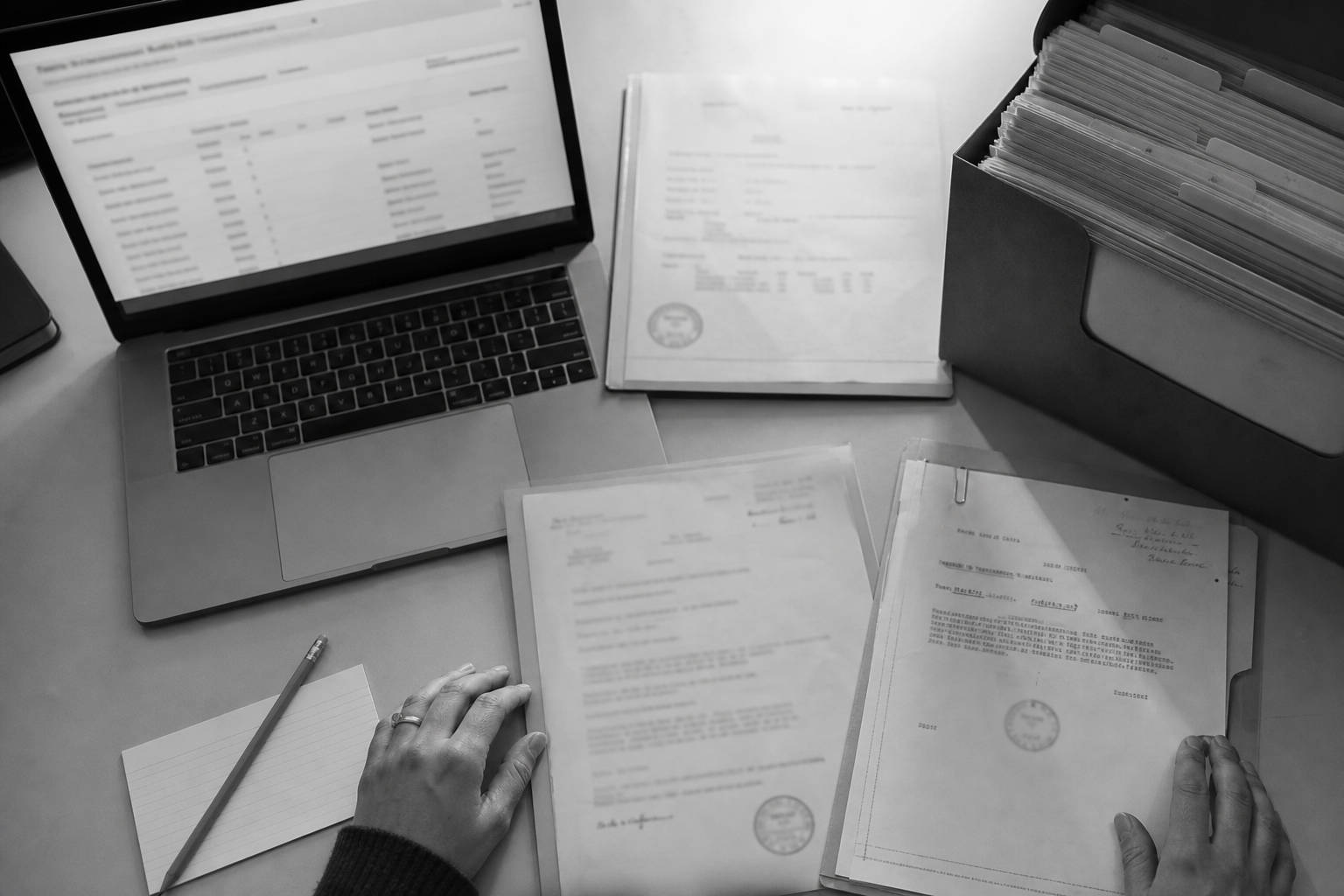
Open the individual catalog record before drawing a conclusion. Its metadata should identify the creator, title, dates, record group or series, and a persistent identifier. Those fields establish where a record sits in the archival chain. A broad result labeled “UFO” with no creator or date is a weak lead; a record tied to a named office, dated correspondence, and a defined series is a usable citation trail.
- Attached digital object: Look for scans, PDFs, images, or other files that can actually be opened. This is the point at which a reader can evaluate the visible document rather than merely its description.
- Finding aid: Use this collection-level inventory to identify box, folder, and series relationships. It can locate relevant material even when no page images are online.
- Access or restriction note: Treat this as a practical limit on use. A record may require an on-site visit, a reproduction request, or further review before it can be viewed.
Save the catalog URL, identifier, title, agency, date range, and the date you accessed it. If a file is attached, preserve the original filename and note redactions, missing pages, and nearby records in the series. That context prevents NARA UFO records from being recirculated as isolated excerpts with a meaning the archival record does not support.
How the NARA Collection Differs From Project Blue Book, AARO, and Agency UAP Reporting
Institutional labels answer different questions. Project Blue Book is a historical reference point: material filed under that name belongs to an earlier investigative context and should be read with its date, creator, stated purpose, and record series in view. A historical file can show what officials received, assessed, or concluded at the time; it does not automatically speak for later agencies or present-day analysis.
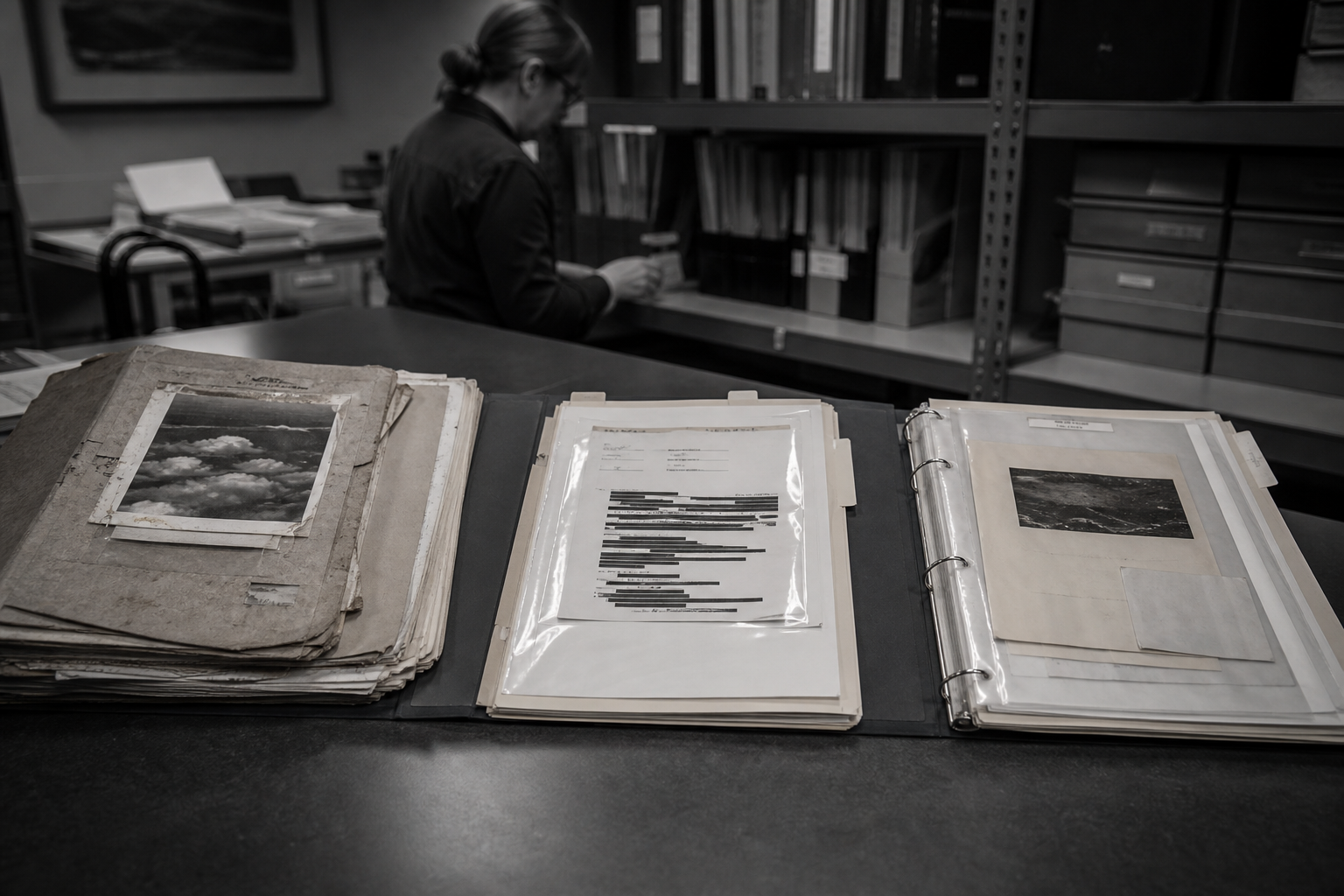
The All-domain Anomaly Resolution Office serves a different function. Its reports, assessments, and public-facing transparency work concern the evaluation of contemporary anomalous-phenomena reporting. An assessment is therefore an analytical product, while a NARA catalog entry, scan, or finding aid is an access and preservation tool. Subject overlap does not turn archival custody into an ongoing investigation, nor does it make an analyst’s conclusion the conclusion of every agency record.
Department of Defense components and other agencies may create, retain, or later transfer records under their own systems. Treat the originating office as the key distinction: a report may record an observation, a briefing may summarize claims, and an assessment may weigh explanations. The strongest reading separates those document types rather than treating “UAP-related” as a single category of proof.
What This Development Does, and Does Not, Establish About UAP Claims
A record’s existence is not the same as proof of the event, object, or allegation it describes. A more centralized discovery route can establish that some government-held UAP-related material is identifiable for public scrutiny, and lets readers compare individual documents against their creators, dates, and surrounding files.
It cannot establish that every relevant record is public, complete, unredacted, digitized, or discoverable through a single search. Nor does inclusion prove alien disclosure, non-human intelligence, reverse-engineering programs, crash-retrieval claims, or a government UFO cover-up. A memorandum may preserve an official’s report or an unverified allegation; it does not, by itself, authenticate the underlying claim.
Use a simple evidentiary hierarchy. A contemporaneous report with a clear author, recipient, date, and corroborating records is stronger than an undated excerpt or a reposted image. Classification markings and redactions show that access is limited, not what the withheld text would prove. Read the actual language: distinguish observations from conclusions, allegations from findings, and uncertainty from confirmation. Provenance, chronology, corroboration, and the full record context remain more important than a provocative title or isolated passage.
A Better Starting Point for UAP Records, Not a Final Answer
That hierarchy is most useful when the next claimed release arrives: treat it as a lead with a provenance trail, not a conclusion. Preserve the originating agency, document date, catalog or series identifier, access notation, and direct file link. A dated Department of Defense memorandum, an AARO assessment, and a Project Blue Book case file may concern a similar subject while serving different historical and institutional purposes.
- A catalog entry makes a holding discoverable through a title, creator, date range, and identifier, but may contain no scanned pages. It establishes that an archival description exists, not that the underlying record can be read.
- A digitized record supplies pages for direct examination. Compare its filename, page count, redactions, and neighboring items in the series; the tradeoff is greater access without a guarantee that the online file is a complete case record.
- A restricted or under-review record identifies an access condition rather than disclosing content. Its absence from public view is not evidence of what unavailable text would establish.
The 2025 framing is therefore most useful as a prompt to follow identifiable additions closely, not to collapse separate historical holdings, agency repositories, and current reporting systems into one record set. Creator, audience, date, and document type determine whether a file records an observation, repeats an allegation, or presents an assessment.
As additional items appear, begin with NARA’s official collection and Catalog links, save the item URL and access date, and trace public claims to the fullest available record. That source-first practice is the sounder basis for interpreting UAP records than screenshots, headlines, or speculation.
Frequently Asked Questions
-
What is the UAP Records Collection at the National Archives?
The UAP Records Collection is a National Archives discovery framework for federal records relevant to unidentified anomalous phenomena. It groups or points to records while preserving each item’s originating agency, date, series, and access status.
-
When did NARA begin releasing UAP records to the public?
No verified dated 2025 NARA launch notice, collection landing-page capture, or catalog identifier for a first UAP-specific release was available as of August 5, 2026. The 2025 label refers to a developing centralized discovery route, not proof that every responsive record was posted, digitized, or declassified at once.
-
How can I search the National Archives UAP Records Collection?
Start from the official collection landing page, follow its Catalog and finding-aid links, and search terms such as “UAP,” “UFO,” and “unidentified anomalous phenomena.” Add an agency or office such as DoD, Air Force, Navy, CIA, or FAA, then save the item’s URL, identifier, title, agency, date range, and access date.
-
How can I tell whether a NARA UAP record is actually available to read?
A catalog entry only describes a record, while a finding aid identifies boxes, folders, and series relationships. Look for an attached digital object such as a PDF, scan, image, or file, and check the access note for redactions, on-site requirements, reproduction requests, or further review.
-
What is the difference between NARA UAP records, Project Blue Book files, and AARO reports?
NARA catalog records, scans, and finding aids are archival access tools, while Project Blue Book files are historical records from an earlier investigative context. AARO reports and assessments evaluate contemporary anomalous-phenomena reporting, so overlapping subject matter does not make archival custody an ongoing investigation or prove a UFO cover-up.