The Mariana (Great Falls) film keeps showing up in UFO news, UAP news, and disclosure threads as if it’s a settled artifact: “4K,” “restored,” “enhanced,” and therefore definitive. You watch the same 12-ish seconds in three different uploads and the objects look like three different things, while each caption insists the latest copy finally proves the point.
That whiplash is the real reason the footage stays controversial. Analysts argue aircraft versus birds versus reflections versus “non-human intelligence” with total confidence, but they often start with interpretation before they establish which version of the film they’re actually looking at. When the input changes, the argument never converges, it just resets, and social media rewards certainty even when the underlying evidence is unstable.
The fix is evidence-first: treat the film as an object with a version history, not as a single, self-explanatory clip. Provenance, meaning the documented chain of custody and reproduction from the camera original to the file on your screen, determines what the footage can support. A high-resolution release labeled “4K” is not automatically better evidence because analog film can be interpreted and reproduced many ways, and the public copy you see may be multiple generations removed from the best surviving element.
Begin by locking down the identifiers that do not move: the filming is dated to August 15, 1950 in Great Falls, Montana, with public retellings commonly placing it in the late morning (approximate) (Wikipedia, Great Falls History Museum, contemporary reporting Great Falls Tribune).
This article lays out a disciplined way to separate what’s known, what’s assumed, and what modern disclosure standards would require before this film can carry the weight people put on it.
Great Falls 1950 and the witnesses
The hard anchors are straightforward: the incident sits in Great Falls, Montana in August 1950, with Nick Mariana documented as the person who filmed it (Wikipedia, Great Falls History Museum).
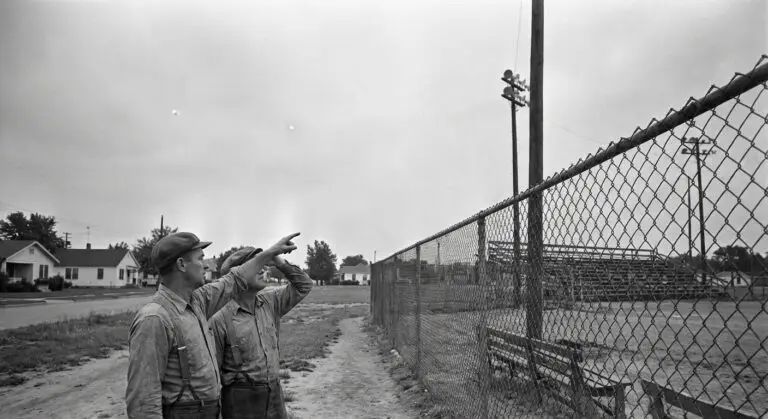
What made Great Falls a place where the story could travel fast was timing. By 1950, “flying saucer” reports were already part of the public conversation, and the Mariana film is consistently framed in that early post-1947 reporting climate rather than as an isolated local oddity.
The complication is that context drives attention, but it does not supply operational specifics. The early Cold War era rewarded urgency, rumor, and rapid retelling, so the broad identifiers tend to harden into “facts” even when the underlying record stays thin.
Mariana matters because he was not introduced to the public as an anonymous witness. In 1950, he is identified as a local baseball coach and manager, a role tied to community visibility and reputational stakes.
He is also described as the general manager of the Great Falls American Legion baseball club, commonly referred to as the “Electrics” (MiLB, Great Falls History Museum).
The available record excerpted here also links the event to another named person, Virginia Raunig, establishing that Mariana was not the only individual associated with the sighting in later documentation.
Known (documented anchors)
- Place it: Great Falls, Montana.
- Date it: August 15, 1950 is the specific date attached to the incident in contemporary and later sources (Wikipedia, Great Falls History Museum, Great Falls Tribune).
- Time it (approximately): Public retellings and secondary listings cluster the filming in the late morning around 11:25 to 11:29 a.m.; a frequently cited precise time is 11:29 a.m. local time (Wikipedia, Great Falls History Museum).
- Attribute it: Nick Mariana is the documented filmer (Wikipedia, contemporary newspaper coverage Great Falls Tribune).
Unknown (not established in the available record)
- An exact minute-by-minute breakdown beyond the reported 11:25 to 11:29 a.m. window.
- The exact filming location (street address or landmark), including any fixed reference point.
- The direction of travel of the observed objects.
- Weather and visibility at the time.
- Any contemporaneous aviation activity documented in local reporting beyond what is presently accessible.
The reason the Mariana episode did not stay purely local is structural: it is repeatedly characterized as an early motion-picture capture, with a brief film segment reported at roughly 12 seconds, which gives retellings a concrete artifact to point to instead of a verbal account alone.
Early circulation in cases like this typically runs on familiar channels: community talk, local interest amplified by recognizable names, and then wider pickup when the event can be summarized in a sentence and tied to a physical record (provenance, documented version history). The central discipline is to separate (a) anchored identifiers like who, where, and the late-morning time window from (b) timeline details that get repeated confidently but are not actually pinned down in the available record.
What the Mariana footage actually shows
Those identifiers are the context; the film itself is the constraint. The surviving public copy is compelling because it is simple: a bright daytime sky, a brief run of frames, and a small number of luminous shapes that traverse the field of view. The objects present as high-contrast highlights, not detailed bodies: they read as bright, compact forms with soft edges rather than as crisp silhouettes with visible structure. Their apparent shape is dominated by brightness, blur, and edge behavior, so viewers tend to report “discs” or “lights” based on how the highlights render, not on any resolved geometry.
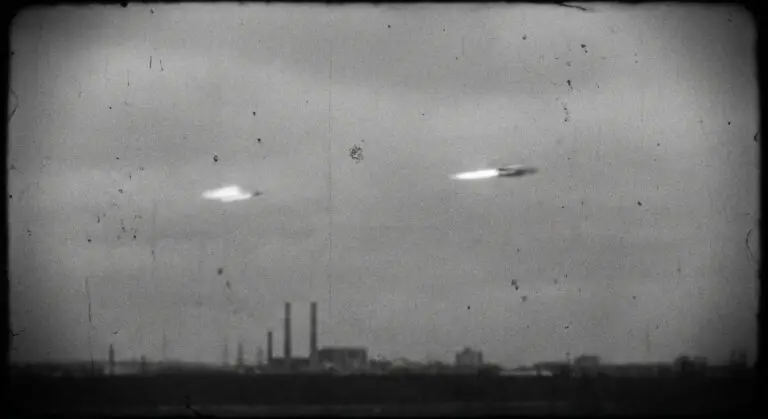
Across the frames, the objects shift position relative to the background while the camera itself also appears to move. That combination matters because it means you are not watching a fixed, surveyed instrument track a target; you are watching handheld or at least human-operated framing where both object motion and camera motion contribute to what looks like speed, climb, or “maneuvering.” The only fully defensible description stays at the surface level: bright objects, limited duration, relative movement across the frame, and no stable, metric reference embedded in the image.
Calling this “16 mm film” is not trivia, it is an evidence constraint: 16 mm is a motion-picture film gauge defined by a 16-millimeter film width, widely used for economical amateur and documentary filming, and the format’s economics and portability shaped how it was shot and how it reproduces. Kodak introduced the 16 mm motion-picture film format and the original Cine-Kodak camera in 1923 (Kodak, Kodak chronology). The Cine-Kodak Model B, a second-generation motor-driven 16 mm camera, was introduced in 1925 (Smithsonian).
The first trap is exposure, meaning the amount of light recorded by film, shaping brightness and detail based on settings and lighting conditions. In practice, exposure is not just “brighter or darker”; it is what decides whether highlights clip into featureless white, whether edges look hard or smeared, and whether the sky background carries texture that could anchor measurements. A slight change in aperture, shutter timing, or scene luminance pushes bright objects into saturation, and once saturated, the “object” you see is partly an optical artifact: halation, flare, and bloom around a bright source can create a disc-like patch that looks larger and more solid than any underlying source would justify.
The second trap is parallax, an apparent shift in an object’s position caused by the observer or camera viewpoint changing relative to the background. If the camera pans, tilts, or shifts position even slightly, distant background features move slowly while nearer features slide faster, and anything with uncertain distance can look like it is accelerating or changing course. This is why stable-looking “motion” can survive repeated viewing: it can be consistent while still being a combined product of camera motion plus line-of-sight geometry, not a clean record of the object’s own trajectory.
The third trap is missing reference points. Without fixed reference points, apparent speed and altitude can be misleading because the image does not supply scale. If you do not know distance to the object, focal length, camera angular rate, and what parts of the background are effectively at infinity, you cannot convert “pixels per frame” into miles per hour or feet of altitude. You can describe angular movement on the image; you cannot responsibly convert it into a physical velocity or height claim from the clip alone.
Light-source geometry amplifies all three traps. In a controlled example from motion-picture testing, two motion pictures were filmed under identical conditions except for the position of the light source, and the sun elevation for one test was 5 degrees. The point is not to map that setup onto this footage; it is to show that illumination angle alone, with everything else held constant, materially changes how a bright object’s edge, contrast, and apparent “shape” present on film.
Frame-by-frame viewing earns its keep when it is used for consistency checks: does the object persist across adjacent frames, does its position evolve smoothly, do its brightness and edge characteristics track with camera motion, and do any artifacts appear or vanish in ways that suggest processing or reproduction effects. That kind of analysis can also separate claims that require only ordering, such as “the object enters, traverses, exits,” from claims that require calibration, such as “it accelerated to X” or “it was at Y altitude.”
Frame-by-frame viewing also invites false precision. Film motion includes motion blur, shutter smear, grain fluctuations, and focus breathing, and those can make adjacent frames disagree in ways that look like shape changes or sudden maneuvers. On top of that, most people are not analyzing the original camera negative; they are analyzing a reproduction. Copy generation and reproduction or scan decisions can materially change perceived brightness and shape through contrast curves, sharpening, stabilization, deinterlacing, compression, and even simple resizing. Treat the clip the way an analyst would treat any measurement problem: separate what is visible from what is measurable, and treat speed or altitude claims as ungrounded unless they are tied to fixed reference points and a known copy lineage with no missing frames.
Military and early UFO investigations
Those measurement limits push attention toward a different question: what, exactly, is the copy being analyzed? The Mariana footage became contentious for a reason that has nothing to do with speculation about what the lights “really were”: once a physical artifact enters official and semi-official channels, the credibility of every later claim depends on how that artifact was handled. In the early Air Force era, UFO reports were treated as an intelligence-adjacent problem set, meaning sightings, photos, and film were routinely collected, logged, and routed for screening rather than left solely in civilian circulation. That investigation culture made sense for air defense and identification, but it also meant the film’s later public life would be shaped by administrative handling: who received it, what was copied, what was returned, and what documentation survived (National Archives, Condon Report).
Serious investigations live or die on transparency. Forensic labs that aim to be credible emphasize full, auditable reporting of scientific work performed on evidence, because conclusions are only as trustworthy as the record that supports them.
“Chain of custody” is not courtroom jargon; it is the minimum engineering spec for trust: a documented, step-by-step record of who handled evidence, when, where, and what was done to it. Chain-of-custody documentation covers collection, transportation, storage, and general handling of evidence, because every move is an opportunity to change condition, context, or even which item is being discussed.
Applied to a piece of motion-picture film, chain of custody is a sequential documentation trail accounting for custody, control, transfer, analysis, and disposition of evidence. An ideal trail would not rely on persuasive storytelling. It would show the physical original being identified and tracked: the camera original roll (or reels), unique identifiers or case numbers, handler names, dates and times, storage locations and conditions, laboratory processing receipts, notes on any splices or repairs, and documentation of every duplication step with “generation” labels (original, first duplicate, later prints). That paperwork matters more than rhetoric because it lets independent readers separate two questions that otherwise get conflated: what is on the film versus what was done to the film.
Legacy UFO film almost never survives as a single pristine object. It survives as a family of copies, and analog film duplicates are not identical to originals; reproduction decisions can materially affect appearance in later copies. Exposure choices during printing, contrast adjustments, optical enlargement, cropping, stabilization, projector or telecine settings, and even the characteristics of the duplicate stock all change what later viewers see as “the footage.”
The practical consequence is straightforward: two people can analyze different copies in good faith and still disagree about apparent brightness, object edge sharpness, jitter, and whether a frame looks “altered.” When the evidence trail does not pin down which generation a viewer is watching and what was done during reproduction, the debate shifts from the filmed scene to the copy chain itself, and that shift is permanent.
Most disputes around the Mariana film cluster in three places: custody gaps, unclear duplication history, and allegations of missing frames. The key point is not which side argues louder. The point is what these controversies do to evidentiary strength. If custody is uncertain, you cannot confidently claim the film in hand is the camera original. If duplication is undocumented, you cannot know whether a suspicious-looking artifact is a property of the scene or a byproduct of printing and transfer. If frames are alleged to be missing, timing and motion analysis stop being clean, because even a small discontinuity breaks frame-to-frame continuity and injects ambiguity into speed, acceleration, and duration claims.
Claims that specific “missing frames” altered interpretation appear in some online accounts; however, that material has been flagged in summaries as unsourced and requests citation (Wikipedia). Project Blue Book and the Condon Report examined the Great Falls film in their respective reviews, but available references stop short of providing a documented frame-by-frame chain showing substituted or deliberately removed frames (Condon Report, National Archives).
Provenance and custody: known vs alleged
Major known custody and public-provenance points (synthesized from available documentary summaries):
- Known: Nick Mariana filmed the event on 16 mm film in Great Falls on August 15, 1950 (Wikipedia, Great Falls History Museum, contemporary coverage Great Falls Tribune).
- Known/Documented transfer: The film was examined by Air Force investigative efforts (Project Blue Book, Condon era reviews); references to Air Force possession and review appear in archival summaries (National Archives, Condon Report).
- Known/public versions: Segments of the Mariana footage have circulated in public museum materials and online uploads; the Great Falls History Museum has published video segments and context (Great Falls History Museum video), and later documentary projects included portions of the film (references in secondary coverage and compilations, see Wikipedia).
Alleged or less-well-documented points commonly reported but not fully documented in the public record:
- Alleged: Specific internal Air Force custody steps, chain-of-custody receipts, and case-numbered transfers for every duplicate generation (publicly available paperwork is incomplete and the documentary trail in public archives is not fully continuous).
- Alleged: Personal testimony about receiving an edited or reduced Air Force print exists in interviews and local accounts (for example, an interview profile of Nicholas Mariana references receiving a copy; see interview reference Nicholas Mariani interview), but an auditable transfer record tied to the original case files is not publicly reproduced in the archives referenced here.
What is missing in the public documentation that would make provenance auditable:
- A documented chain-of-custody ledger or handover receipts showing each transfer step from camera original to any Air Force custody to later copies returned or retained.
- Laboratory processing receipts showing print/duplication generations and stock types used.
- A complete listing of publicly available archival item identifiers for moving-image holdings tied to this incident in the National Archives or other repositories.
Summaries and museum reproductions help with public access, but they do not substitute for the documentary ledger that would let an independent lab verify whether a given circulating file is a first-generation print, an edited Air Force print, or a later copy with unknown processing history (National Archives, Great Falls History Museum).
If the handling record were complete and the source material clearly identified, technical analysis could be far more decisive. Photogrammetry, used properly, is a measurement approach that uses images to estimate real-world geometry, motion, or scale under stated assumptions. In film terms, it can turn pixels and frame counts into angles, trajectories, and size bounds, but only if the inputs are nailed down.
Those assumptions are demanding: known frame rate (including any transfer-induced changes), known camera and lens parameters, a verified copy generation with no undocumented resizing or cropping, stable reference points in the scene for calibration, and continuity with no missing or substituted frames. Without that foundation, photogrammetry does not become “impossible,” it becomes non-falsifiable. Analysts can always produce a model that fits one copy, but readers have no way to know whether the model is describing the sky or describing the duplication chain.
The standard to apply to any legacy UFO film is therefore procedural: demand handling documentation first. When the record clearly shows who had the film, what was copied, how it was copied, and where the original lived, technical conclusions tighten. When that trail is broken or undocumented, downgrade every confident claim, regardless of which conclusion it supports.
Debunk claims and unresolved questions
Once copy lineage and continuity are treated as first-order constraints, the remaining debate reduces to competing models for what could produce the same bright, high-contrast shapes in a short daytime film segment. The table below lays out what each hypothesis accounts for, what it leaves exposed, and what kind of record would actually resolve it.
| Hypothesis | What it explains | What it struggles to explain | What would decide it |
|---|---|---|---|
| Reflections (window, lens, internal camera reflections) | Bright, high-contrast “objects” that keep a similar apparent size and can look metallic in strong sun. A reflection also explains why motion can look oddly smooth or “detached” from the background. | Any consistent interaction with the outdoor scene: parallax that matches real distance, occlusion by foreground elements, or motion that cleanly matches a plausible external track. Without the original camera handling context, reflection arguments become interpretive. | Original film and camera notes plus reenactment: same camera model, same lens and filters, same filming position, same sun angle. If a controlled reproduction generates the same shapes and timing, the reflection case closes. |
| Aircraft (jets at distance) | Specular sun glint off wings or fuselage that flashes and then disappears with small changes in viewing angle. Apparent “fast” motion can be a range illusion: a distant aircraft crossing a wide sky can look abrupt on short footage. | Distance and identity. A single, silent, short film segment cannot supply range, altitude, or a tail number. If frames are missing, timing and speed calculations become fragile. | Contemporaneous operations proof: base flight schedules, tower logs, pilot reports, and maintenance documentation that ties an aircraft to the right place and time. |
| Birds (gulls and similar) | Small bright bodies can “blink” as wings roll through sunlight. Erratic changes in apparent direction or brightness read as natural flapping or banking. | Scale. Without a reference distance, “bird” becomes a catch-all for any small bright object, and it fails if motion is too uniform or if shapes persist without wingbeat cues at the available frame rate. | Frame-accurate motion plus environmental corroboration: verified wind direction and speed at filming time, local bird activity records if available, and a high-fidelity scan showing wing articulation rather than a single saturated blob. |
| Balloons (weather or advertising) | Stable brightness and slow drift can look like a smooth “object” if the camera pans or if the film sample is brief. A balloon also explains why an object could remain visible without obvious propulsion cues. | If the motion looks purposeful or too fast relative to likely wind, the balloon explanation needs wind data to survive. Balloons also tend to show deformation or tether behavior when close enough to resolve. | Weather records and launch logs: wind profiles aloft, documented balloon releases, and a trajectory consistent with a passive drift model from a known launch point. |
| “Unknown” (unidentified with current record) | Accounts for the honest limit: multiple mundane hypotheses can be argued from the same thin visual record, and none is clinched with the surviving material. | “Unknown” is not a positive identification. It collapses if decisive documentation surfaces for any conventional source, or if the film’s provenance cannot support precise measurement. | Preserved originals and independent corroboration: original film, verified camera parameters, synchronized time and location, and at least one external record (air ops, meteorological, or multi-sensor) that locks the object to a physical range. |
The friction point in Great Falls is that every hypothesis leans on timing, continuity, and geometry, and those are exactly what get undermined when analysts suspect missing frames or processing damage. When the record is that thin, rhetoric substitutes for documentation.
For the aircraft bucket in particular, the deciding evidence is rarely cinematic. Contemporaneous operational records such as sortie logs, tower logs, and unit histories are the kinds of paperwork that can either lock in an aircraft match or weaken it by showing nothing was scheduled or airborne where the film was shot (National Archives).
The hypotheses also imply a practical standard for closure: either the film package becomes audit-grade, or the case remains structurally open. In procedural terms, decisive work would look like the following:
- Produce the best-available original: the earliest generation film element plus a documented scan workflow (resolution, colorimetry, compression-free master).
- Verify capture parameters: camera model, lens focal length, shutter behavior, frame rate, and any filters used.
- Pin time and geometry: exact filming location, compass bearing or azimuth to the objects, and sun position for that minute.
- Corroborate with external records: airfield logs and flight schedules, local weather and winds aloft, and any contemporaneous witness notes that can be time-synced.
- Recreate the best competing model: controlled tests that reproduce the same apparent motion and brightness pattern for reflections, aircraft glint, birds, or balloons.
Modern identification often relies on multi-sensor and electronic data rather than visual footage alone; contemporary offices tasked with coordinating UAP detection and analysis emphasize normalized collection, tracking, and analysis practices that combine sensors, human reporting, and records management (AARO mission).
Standards of evidence shifted hard after mid-century. Today’s expectations emphasize metadata, multi-sensor corroboration, and preserved originals. Early cases often have compelling stories and limited imagery, but they lack the decisive layers that turn competing narratives into a closed identification. The operative question remains: “What record would decide this?” Every conclusion stays provisional until that checklist is met.
Why the film matters in UAP disclosure
The same issues that keep the Great Falls debate open are exactly why the film keeps resurfacing. The Mariana film matters now for one reason: modern UAP disclosure arguments are arguments about records, not just imagery. Legacy cases resurface in UFO news and UAP news because they sit at the intersection of high public interest and low evidentiary completeness. That mismatch turns the same reels into recurring proxy battles over trust: what was captured, what survived, who handled it, and what changed along the way.
The friction is structural. Historical film often circulates in copies with lost information, including allegations of missing frames and processing damage, which collapses technical debates into transparency debates because basic archival questions cannot be answered from the artifact people are arguing over. Public summaries and institutional commentary note that the Mariana footage was examined by Air Force investigators and by later scientific reviews such as the Condon Survey (Condon Report, National Archives).
Today’s standard is not “a clearer video.” It is a record package that can be audited. That is exactly what most 1950-era material cannot supply: consistent provenance, capture metadata, and documented handling from camera to analyst. Without those, even sincere analysis hits a hard ceiling because you cannot separate camera artifacts, duplication artifacts, and editing decisions from the underlying event.
- Originals (first-generation files or film elements, not broadcast copies)
- Metadata (time, location, device settings, lens, frame rate, compression, and version history)
- Documented handling (chain of custody, storage conditions, and every conversion or enhancement step)
- Corroboration (multi-sensor data like radar, IR, EO, and comms logs matched to the same time window)
AARO’s mission and reporting requirements, the U.S. Department of Defense office tasked by Congress with coordinating UAP data collection, analysis, and reporting, sits at the center of this shift because disclosure lives or dies on record management. The FY2023 NDAA, enacted in December 2022 as Public Law 117-263, included provisions directing reporting on historical UAP records and related responsibilities for DoD; the enacted public law text and bill are available from Congress and govinfo (H.R. 7776 (117th): text, Public Law 117-263). AARO’s mission statement and public materials describe its role in synchronizing detection, tracking, and analysis of anomalous phenomena (AARO mission, AARO mission brief).
The FY2024 NDAA, enacted as Public Law 118-31 on December 22, 2023, likewise included UAP-related provisions; the enacted statute is published online (Public Law 118-31 text, govinfo).
Apply a process filter before reacting to the headline. Treat “enhanced” clips as marketing until the audit trail is visible. Credible disclosure looks like releases where the government or a lab can show originals, associated metadata, and documented handling, then connect the visuals to independent sensor logs. If a 2025 to 2026 case update cannot answer basic questions about source files, custody, and corroboration, it is repeating the Great Falls problem with better resolution and the same missing paperwork.
A century-old question in moving frames
The Mariana footage endures because it is a rare early motion-picture case with just enough certainty to anchor debate: public summaries consistently agree on a filming date of Aug 15, 1950, a location in Great Falls, Montana, and the plain fact that motion-picture footage exists (Wikipedia, Great Falls History Museum). Those anchors still matter because they let you separate what is historically fixed from what is interpretive. The core process lesson from the handling and analysis sections is equally fixed: provenance, copy lineage, and reproducibility set the ceiling on what you can responsibly conclude. If you cannot tie a claim to a specific source element and reproduce it across equivalent materials, you are not doing analysis, you are doing interpretation.
What remains contested is object identity, and the reason is structural: the decisive evidence lives in version history and contemporaneous documentation that are incomplete, disputed, or both. Even honest analysts can diverge when later reproductions and scans differ substantially from earlier circulated copies, because analog negatives and analog copies can be interpreted in multiple ways and each duplication or transfer can alter contrast, scale cues, and apparent edges. Add the film-mechanics limits already laid out, scarce reference points for measurement and analog reproduction effects that shift what a viewer thinks they see, and the hypothesis matrix lands where it has to: no surviving package of materials closes the case decisively. Modern UAP processes now emphasize preservation and historical record-building as a first principle, aligning incentives around what can be verified later, not what can be argued today.
For every UAP headline in 2025 to 2026, demand originals, metadata, and documented handling before you accept anyone’s identity claim.
Frequently Asked Questions
What is the Mariana (Great Falls) UFO film?
The Mariana film is a brief motion-picture clip (about 12 seconds) showing a small number of bright objects moving across a daytime sky. It is consistently associated with Great Falls, Montana and is cited as an early motion-picture UFO case.
When and where was the Mariana UFO film shot?
The filming is dated to August 15, 1950 in Great Falls, Montana. Public retellings place it in the late morning, commonly around 11:25 to 11:29 a.m.
Who filmed the 1950 Great Falls UFO footage?
Nick Mariana is the documented person who filmed the footage. He is described in 1950 accounts as a local baseball coach/manager and general manager of the Great Falls American Legion team commonly called the “Electrics.”
What film format was used for the Mariana UFO clip (specs)?
The article describes it as 16 mm motion-picture film, a gauge defined by a 16-millimeter film width. It notes 16 mm was developed by Kodak in 1923 as a smaller, portable format that captures less fine detail than 35 mm.
Why do “4K restored” versions of the Mariana film look different from each other?
The article says the film survives as a family of copies, and analog duplication plus modern scanning can change contrast, brightness, edge sharpness, and apparent shape. It warns that a file labeled “4K” may be multiple generations removed from the best surviving film element.
What makes speed or altitude claims from the Mariana film unreliable?
The clip lacks stable reference points, and the camera appears to move, so perceived motion mixes object motion with camera motion and parallax. Without known distance, focal length, frame rate, and a verified copy lineage with no missing frames, the article says you can’t convert image movement into physical speed or altitude.
What should you look for before trusting an “enhanced” UAP clip like the Mariana film?
The article says to demand an auditable record package: the best-available original element, metadata (time, location, device settings, lens, frame rate, version history), and documented chain of custody. It also calls for external corroboration such as airfield logs, weather/winds aloft, or other sensor records matched to the same time window.