Kenneth Arnold’s June 1947 Sighting Near Mount Rainier
What Kenneth Arnold reported on June 24, 1947, how the flying-saucer phrase emerged, and what the National Archives record can and cannot establish.
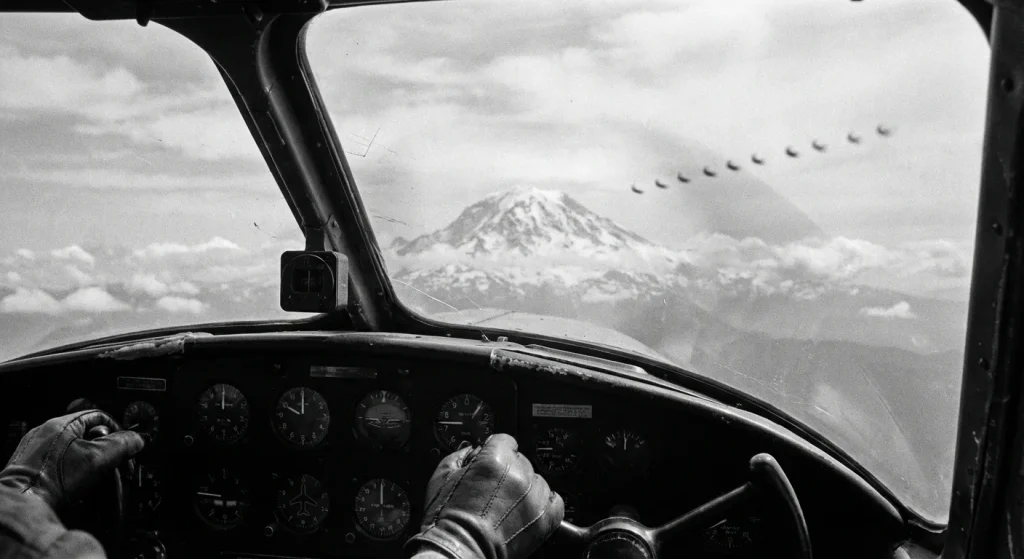
On June 24, 1947, private pilot Kenneth Arnold reported seeing nine fast-moving, unusual objects while flying near Mount Rainier in Washington state. In interviews and early news coverage, Arnold said the objects moved in a way he compared to a saucer skipping across water, a description that helped spark the “flying saucer” label. The report became notable because it was widely publicized and is often cited as an early flashpoint of the modern UFO wave in the United States.
Summary of the 1947 Report
Arnold reported that he observed nine objects traveling generally southward, moving from the vicinity of Mount Rainier toward Mount Adams. He estimated the sighting lasted roughly two to three minutes, long enough for him to watch their formation and apparent motion. In early accounts reported by newspapers and later historical summaries, Arnold estimated their speed at around 1,200 mph based on the time it took them to cover the distance between known landmarks; this figure is often described as his own estimate rather than a measured value. Descriptions attributed to Arnold commonly include that the objects appeared bright or reflective, seemed to “flash” as they moved, and traveled in a line or echelon-like formation, with motion he likened to a saucer skipping across water.
Contemporaneous reporting and later historical work vary in phrasing, but the core elements—nine objects, near Mount Rainier, a brief observation window, rapid apparent speed, and the “skipping saucer” comparison—are consistently reported in early press coverage and subsequent summaries (e.g., History.com; Encyclopaedia Britannica). For a primary-source perspective, Arnold’s recollections were also preserved in later interviews and publications (commonly cited via Arnold’s own accounts, including his 1952 book “The Coming of the Saucers,” co-authored with Ray Palmer).
Why the Sighting Became Famous
Arnold’s report received rapid and widespread newspaper coverage and helped popularize the “flying saucer” phrase in the U.S. media. The combination of a named witness (a pilot), specific numerical details (nine objects), and a vivid motion analogy made the story easy to repeat and compare with other reports. In many historical overviews, it is treated as a catalyst event that helped trigger a broader wave of “flying saucer” reports in mid-1947 and shaped the language used to describe them in subsequent decades.
FAQ
-
What happened in the Kenneth Arnold sighting?
Kenneth Arnold, a private pilot, reported seeing nine unusual objects in flight near Mount Rainier on June 24, 1947. In widely repeated descriptions attributed to Arnold, the objects appeared bright/reflective and moved with an unusual skipping or bounding motion—an analogy that contributed to the “flying saucer” label in press coverage.
-
Where and when did Arnold report seeing the objects?
Arnold reported the sighting on June 24, 1947, in the Mount Rainier area of Washington state, with accounts commonly describing the objects traveling generally southward toward Mount Adams.
-
How long did the observation last and what speed did Arnold estimate?
Accounts commonly report an observation duration of roughly two to three minutes. Arnold estimated a very high speed (often quoted around 1,200 mph) based on how quickly the objects seemed to traverse the distance between landmarks; this figure is presented in sources as his estimate rather than an instrumented measurement (see summaries such as History.com and Encyclopaedia Britannica).
-
Why is the Kenneth Arnold report historically significant?
It became one of the most publicized early UFO reports in the United States and is frequently cited as a key moment in the 1947 “flying saucer” wave. The story’s rapid circulation in newspapers and Arnold’s memorable motion comparison helped shape the terminology and expectations surrounding later UFO/UAP reports.
-
How do investigators and historians interpret the report today?
Interpretations vary, ranging from conventional explanations (misidentified aircraft, atmospheric effects, or distant objects viewed under unusual conditions) to more speculative views. Historical summaries generally treat it as an influential media and cultural event—widely reported and repeatedly retold—whether or not a definitive identification of what Arnold saw can be established.
What survives in the official archive
Kenneth Arnold reported the observation on June 24, 1947, while flying near Mount Rainier in Washington. In its history of Project Blue Book, the National Archives describes Arnold reporting nine objects moving in formation and an estimated speed of roughly 1,700 miles per hour. That number was Arnold’s estimate from the observation, not a modern instrument-derived measurement.
The familiar phrase “flying saucer” also needs context. Arnold’s description compared the objects’ motion to saucers skipping on water; press coverage compressed that analogy into a label that quickly became part of popular culture. The report helped trigger a wave of public sightings and military attention that preceded Project Sign and the later Project Blue Book investigation.
The National Archives identifies a digitized copy of Arnold’s report in its catalog, allowing readers to compare later retellings with the surviving record rather than relying on folklore alone.
Primary record guide
National Archives: Project Blue Book’s 50th anniversary and the Kenneth Arnold report.
Evidence note: The archive establishes what Arnold reported and its historical influence. It does not independently verify the objects’ distance, dimensions, speed, or identity.